

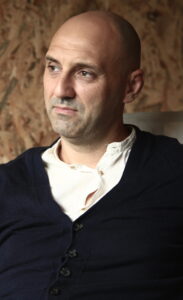
Nasce l’8 Settembre 1981 a Foligno in Umbria dove rimane fino alla maggiore età. Si laurea nel 2007 in Scienze della Comunicazione nell’ateneo di Perugia con una tesi sul cine-documentario d’autore. Tra il 2004 e il 2005 è a Madrid (Spagna), partecipa al progetto Erasmus nella facoltà di Ciencias del la Información nell’ateneo delle Real Complutense de Madrid, ha così la possibilità di frequentare classi di produzione audiovisuale e cinema sperimentale. Qui gira il suo primo lungometraggio dal titolo “A Luglio Ritorno”, un resoconto pseudo-autobiografico sulla “vita erasmus”. All’inizio del 2008 si trasferisce a Barcellona, dove entra in contatto con il cinema indipendente catalano. Nel Giugno 2008 è di ritorno in Umbria dove ispirato dall’esperienza barcellonese, passa alcuni mesi come volontario in alcune strutture sanitarie che ospitano persone con gravi patologie mentali e gira il documentario “Benvenuto signor nessuno”. Al principio del 2009 è ancora a Madrid dove partecipa al Master in Cinematografía Digital y Nuevos Medios promosso dalla ECAM (Escuela de la Cinematografía y del Audiovisual de la Comunidad de Madrid) e dall’università Ray Juan Carlos. Nell’estate torna in Italia per girare alcuni brevi documentari di carattere sociale e culturale. Nel dicembre del 2009 è a Taiwan; partecipa al Hweilan International Artists Workshop, dove collabora con un team internazionale alla realizzazione di istallazioni d’arte contemporanea nelle quali cura la parte audio-video. Decide di rimanere a Taiwan per un anno dove venendo a contatto con le culture indigene gira alcuni brevi documentari di carattere antropologico.
Durante questo periodo ha l’opportunità di conoscere l’estremo oriente (Cina, Giappone, isole Ryukyu, Singapore, Cambogia) e di girare molto materiale di repertorio. Inizia a scrivere Stileliberty, che verrà alla luce solo dopo più di 3 anni di lavoro, all’inizio del 2014. Alla fine del 2010 torna in Italia e si dedica esclusivamente alla realizzazione di Stileliberty, nel quale, al materiale girato in Asia, integra nuovo materiale prodotto principalmente in Umbria. Dal 2015 risiede in pianta stabile a Hualien nella costa orientale di Taiwan per seguire un progetto documentario sulle culture dei popoli indigeni locali dal titolo –NiiNami- (Here we are) ancora in fase di produzione. Attualmente collabora con i principali festival di arte contemporanea e land-art della costa orientale producendo documentari. Tra il 2017 e il 2019 ha esposto nei più importanti musei di Taiwan, rispettivamente nel MOCA Taipei con l’opera -Casi Humani- e nel museo di Taitung (National Museum of Prehistory) in quello di Kaoshiung (Kaohsiung Museum of Fine Arts), nel Gyeonggi Museum of modern art (Sud Corea), con l’istallazione K- Fragment. Il 5 ottobre 2019 esce con la video-istallazione dal titolo “Tribum” al festival “Original Living Art Fest” nella città di Hualien (R.O.C), opera incentrata sulla cultura e sul paesaggio dell’Umbria.
Nel 2020 Presenta “A-Ken L’ultimo dei selvaggi” documentario A-ken /王庚 (虛擬人物), personaggio di riferimento della nuova cultura underground taiwanese, venuto a mancare alla fine del 2019 e con cui strinse negli anni precedenti una profonda amicizia.
Nel 2021 esce Dungku Asang, documentario a carattere ambientalista, girato su una cava di serpentinite a 1200 metri di altitudine a ridosso della Rift Valley taiwanese. Il progetto vince il premio come miglior documentario e miglior montaggio al festival del cinema di Hualien (花蓮鐵道電影院) e miglior fotografia al Senao festival (2022神腦原鄉踏查紀錄片競賽-得獎公告) e nel 2024 è selezionato al “Taiwan Film Festival in Australia”.
Nel 2021 inizia una collaborazione con la stazione televisiva TITV (Taiwan Indigenous Television) per la realizzazione di un documentario sulla caccia tradizionale della tribù Seddiq-Truku. Il film nel settembre del 2023 vince riceve 4 candidature al TEEFF festival del cinema dedicato all’ambiente e vince il premio come miglior montaggio, ed è selezionato in tre categorie, tra cui miglior regia, al Golden Bell awards del 2023, premio annuale per la produzione televisiva e radiofonica taiwanese, aggiudicandosi il premio come miglior ambientazione sonora. Nel 2024 riceve la candidatura come miglior regia all’ Asian Tv Awards e vince il Silver Remi Awards al 5tth Huston Worldfest.
- English
Tommaso Muzzi (8 September 1981) spent the first 18 years of his life in Foligno, in Italy’s so called “green hearth” Umbria region. Between 2004 and 2005 he was at the “Complutense University” (Madrid – Spain) with a 9 months Erasmus exchange scholarship. During this time he focused on experimental cinematography and audio—visual productions, and he filmed his first long movie A Luglio Ritorno (I’ll Be Back in July). The movie is a pseudo- –self biographic cine—documentary on the Erasmus students’ lifestyle.In 2007 he graduated in “Communication Sciences” from the University of Perugia (Italy), with a dissertation on cine—documentary film. In early 2008 he was based in Barcelona, where he had the chance to get involved with the Catalan independent cinematography milieu. Here he learned about the so called “creative documentary” that is an anthropological Malinowskian style of filming: according to this methodology and for the sake of authenticity, film—makers become one thing with the context of the story. He adopted this approach between June and December 2008, when he volunteered in a foster home for mental health inpatients in Italy. Here he directed the documentary Benvenuto Signor Nessuno (Welcome Mr Nobody), and he worked side by side with people affected by either mild or severe forms of mental suffering.Starting in January 2009 he attended a 6 months Master in Digital Cinematography and New Media, by ECAM (Community of Madrid School of Audio—Visual and Cinematography) and “Ray Juan Carlos University”. In July 2009 he went to Uganda as his movie A Luglio Ritorno was selected for a festival in Kampala; the festival was among the GSItalia association initiatives for the project “Young and Active Citizenship” funded by EACEA.Between August and September he directed “Scacciadiavoli”: a documentary about the rural life and memories of Italian farmers and wine producers. In December he went to Taiwan and he took part in the “Hweilan International Artists Workshop”, involving a team of international artists with the purpose of producing contemporary art installations. He was responsible for the audio—visual part of the workshop. He decided to stay in Taiwan for a year, during which he learned about indigenous/Austronesian culture. He worked within indigenous communities and he directed a few short documentaries: During 2010 he also travelled around Eastern Asia in countries including China, Japan, Ryukyu Islands, Cambodia, Singapore, where he filmed repertoire contents, and he started to write the movie Stileliberty. From December 2010 he had been working almost exclusively in Umbria (Italy) on Stileliberty, until the movie was finally ready in January 2014.He is currently working on a project called Here We Are, focusing onSince 2015 he live in Hualien city on the east coast Taiwan, working on a film-documentary named –NiiNami- (Here we are) focus on the cultures of local indigenous peoples.It still in the production phase.
He currently collaborates with the main Taiwan east coast contemporary art and land-art festivals such as Mipaliw, Living Art Festival and Taiwan EastCoast festival, producing documentaries and promotion films. Between 2017 and 2019 he exhibited in the most important museums of Taiwan, respectively in MOCA Taipei with the opera -Casi Humani- and in the museum of Taitung (National Museum of Prehistory) and in that of Kaoshiung (Kaohsiung Museum of Fine Arts )in the Gyeonggi Museum of modern art (South Korea) and at the photography festival “Castelnuovo Fotografia”, with the installation named “K-Fragment”. On October 5 – 2019 with a video-installation named “Tribum” take part at the “Original Living Art Fest” in Hualien City (R.O.C), a work focused on the culture and landscape of Umbria (Italy).
In 2020 He presents “A-Ken The Last of the Savages” documentary A-ken / 王 庚 (虛擬 人物), a reference figure of the new Taiwanese underground culture, who passed away at the end of 2019 and with whom he held a deep friendship.
In 2021, Dungku Asang, an environmentalist documentary, filmed on a serpentinite quarry at 1200 meters above sea level close to the Taiwanese Rift Valley, was released. The project won the award for best documentary and best editing at the Hualien film festival (花蓮鐵道電影院) and best photography at the Senao festival (2022神腦原鄉踏查紀錄片競賽-得獎公告) and in 2024 it was selected for the “Taiwan Film Festival in Australia”.
In 2021 a collaboration began with the television station TITV (Taiwan Indigenous Television) for the creation of a documentary on the traditional hunting of the Seddiq-Truku taiwan indigenous tribe. In September 2023, the film received 4 nominations at the TEEFF film festival dedicated to the environment and won the award for best editing, and was selected in three categories, including best director, at the 2023 Golden Bell awards, the annual award for Taiwanese television and radio production, winning the award for best sound setting. In 2024 he received the nomination for best director at the Asian TV Awards and won the Silver Remi Awards at the 5th Huston Worldfest.
- 中文
Tommaso Muzzi(1981年9月8日生)在義大利翁布里亞(Umbria)地區的福利尼奧(Foligno)度過了人生的前18年,該地區常被稱為義大利的「綠色心臟」。2004至2005年間,他以伊拉斯莫斯交換生身份,在西班牙馬德里的康普頓斯大學(Complutense University)學習九個月。在此期間,他專注於實驗電影與視聽創作,並拍攝了他的第一部長片《A Luglio Ritorno》(《我將於七月歸來》),這是一部帶有自傳性質的紀錄電影,描繪伊拉斯莫斯學生的生活方式。
2007年,他於義大利佩魯賈大學(University of Perugia)取得傳播學學位,並以紀錄片電影為題完成論文。2008年初,他移居巴塞隆納,並參與當地加泰隆尼亞的獨立電影圈。在此期間,他接觸到所謂的「創意紀錄片」形式,這是一種源自馬林諾夫斯基(Malinowski)人類學方法的拍攝方式,強調導演需融入拍攝情境,以達到真實性。2008年6月至12月期間,他在義大利一所精神健康照護機構擔任志工,並運用此方法拍攝紀錄片《Benvenuto Signor Nessuno》(《歡迎你,無名先生》),與不同程度精神困擾的患者共同生活與工作。
2009年1月,他參加由ECAM(馬德里視聽與電影學校)與胡安卡洛斯國王大學(Rey Juan Carlos University)合辦的數位電影與新媒體碩士課程,為期六個月。2009年7月,他前往烏干達坎帕拉,因其作品《A Luglio Ritorno》入選當地影展,該影展為GSItalia協會「青年與積極公民」計畫的一部分,由EACEA資助。
同年8月至9月,他執導紀錄片《Scacciadiavoli》,記錄義大利農民與釀酒者的鄉村生活與記憶。12月,他前往台灣,參與「洄瀾國際藝術家工作坊(Hweilan International Artists Workshop)」,與來自世界各地的藝術家共同創作當代藝術裝置,並負責視聽部分。此後,他決定在台灣停留一年,期間深入了解南島語系與原住民族文化,並在部落中工作,拍攝多部短篇紀錄片。
2010年期間,他亦遊歷東亞地區,包括中國、日本、琉球群島、柬埔寨與新加坡,進行影像素材的拍攝,並開始撰寫電影《Stileliberty》。自2010年12月起,他幾乎專注於該片製作,最終於2014年1月完成。
自2015年起,他定居於台灣東部花蓮市,並持續製作紀錄片《NiiNami》(《Here We Are》),聚焦當地原住民族文化,目前仍處於製作階段。
他亦與台灣東海岸多個重要的當代藝術與地景藝術節合作,包括Mipaliw、東海岸大地藝術節(Living Art Festival)及Taiwan East Coast Festival,負責紀錄片與宣傳影片製作。
2017年至2019年間,他於多個重要美術館展出作品,包括台北當代藝術館(MOCA Taipei)的《Casi Humani》,台東國立史前文化博物館、高雄市立美術館,以及韓國京畿道現代美術館(Gyeonggi Museum of Modern Art),並於「Castelnuovo Fotografia」攝影節展出裝置作品《K-Fragment》。2019年10月5日,他以影像裝置《Tribum》參與花蓮「原創生活藝術節(Original Living Art Fest)」,作品聚焦於義大利翁布里亞的文化與地景。
2020年,他發表紀錄片《A-Ken The Last of the Savages》,主角A-Ken/王庚(虛擬人物)為台灣地下文化的重要象徵人物,並於2019年底辭世,與導演有深厚友誼。
2021年,他推出環境紀錄片《Dungku Asang》,拍攝地點為台灣縱谷附近海拔1200公尺的蛇紋岩採石場。該片榮獲花蓮電影節最佳紀錄片與最佳剪輯獎,並於2022神腦原鄉踏查紀錄片競賽中獲得最佳攝影獎,並於2024年入選「台灣電影節(澳洲)」。
同年,他開始與原住民族電視台(TITV)合作,拍攝賽德克族與太魯閣族傳統狩獵文化紀錄片。2023年9月,該片於環境主題影展TEEFF獲得四項提名並奪得最佳剪輯獎,同時入圍第58屆金鐘獎三項大獎(包括最佳導演),並榮獲最佳音效獎。
2024年,他入圍亞洲電視大獎(Asian TV Awards)最佳導演,並於第5屆休士頓國際影展(Houston WorldFest)獲得Silver Remi Award。